A proven standard in hyperhidrosis treatment
Sie sind bereits registriert?
Loggen Sie sich mit Ihrem Universimed-Benutzerkonto ein:
Sie sind noch nicht registriert?
Registrieren Sie sich jetzt kostenlos auf universimed.com und erhalten Sie Zugang zu allen Artikeln, bewerten Sie Inhalte und speichern Sie interessante Beiträge in Ihrem persönlichen Bereich
zum späteren Lesen. Ihre Registrierung ist für alle Unversimed-Portale gültig. (inkl. allgemeineplus.at & med-Diplom.at)
Primary hyperhidrosis significantly impairs quality of life. This article reviews the role of botulinum toxin A as a safe and effective therapy, highlights proper patient assessment with the Minor starch test, and provides practical guidance on dosing, injection techniques and pain management in daily clinical practice.
Keypoints
-
Botulinum toxin A is an effective, well-established treatment for primary focal hyperhidrosis.
-
Objective assessment with the Minor starch test is essential for diagnosis, dosing and prognosis.
-
Axillary hyperhidrosis responds reliably to standardized injection techniques and dosing.
-
Different botulinum toxin formulations are not biologically equivalent and require dose conversion.
-
Optimized anaesthesia techniques improve patient comfort, especially for palmar injections.
A toxin gets a useful drug
During the Second World War, much research was done in the United States at Fort Detrick, Maryland, principally by Edward J. Schantz1 who was searching for an antidote to counter botulinum toxin which was thought to be a potential biological weapon ready to be used by several other countries. In 1949 Burgen showed that the block of acetylcholine release by botulinum toxin (BTX) occurred in the presynaptic nerve endings and not, as previously believed, by postsynaptic blockage of receptors, like atropine. In the 1960s ophthalmologist Alan Scott2 was searching for a non-surgical alternative for the treatment of strabismus. His idea to weaken the extra-ocular muscles with BTX brought him in contact with Ed Schantz. After several trials on monkeys, botulinum toxin sero-type A (BTX-A) was approved in 1989 by the Federal Drug Administration for the treatment of strabismus, blepharospasm and hemifacial spasm. Other fields of medicine quickly became interested, and BTX-A was used for a wide variety of indications, in particular for the treatment of hyperkinetic muscles. Bushara3 was the first to suggest a possible indication for BTX-A in the treatment of hyperhidrosis. The first patient in Switzerland was treated 1998 at the Dermatology Department of the University Hospital of Zurich (USZ). In 2000 it could be shown that 2 units of BTX per injection point are sufficient to treat axillary hyperhidrosis.4 Since 2002, BTX-A has been approved for the treatment of axillary hyperhidrosis in most of the countries.
Commercially available botulinum toxin A
Botulinum toxin type A purified neurotoxin complex is presently available as three different main toxins:
-
Onabotulinum toxin: Botox®/Vistabel® (Allergan, Irvine, CA, USA)
-
Abobotulinum toxin: Dysport®/Azzalure® (Ipsen Ltd, Wrexham, UK and Galderma, CH)
-
Incobotulinum toxin: Xeomin®/Boucuture® (Merz Aesthetic, Frankfurt, Germany)
There are new toxins on the market like daxibotulinum A (Daxxify®, Revence Therapeutics, USA), letibotulinum A (Letybo®, Hugel South Korea) and two different ready-to-use purified toxins: abobotulinum toxin RTU (Alluzience®) and relabotulinum toxin (Relfydess®), both from Galderma, Switzerland.
Onabotulinum and incobotulinum are comparable in their efficacy, their duration of efficacy and their onset of action. Except the two ready-to-use toxins all toxins are distributed in the form of a dry, crystalline powder and must be reconstituted with 0.9% physiological saline. It is very important to note that the equivalent U for abobotulinum is not the same as for ona- and incobotulinum. This is due to different bacterial strains and manufacturing processes. The dose-conversion factor between onabotulinum/incobotulinum and abobotulinum is 1:2.5 (Table 1). Abobotulinum is offered in a 125U vial (corresponding to 50U ona- or incobotulinum) to make it easier for the treating physician.

Tab. 1: The dose-conversion factor between onabotulinum/incobotulinum to abobotulinum
The biological activity of all products is defined in mouse units (MU) or just units (U): One mouse unit is defined as the amount of neurotoxin that is lethal in 50% of female, 18–22g Swiss Webster mice (i.e. lethal dose LD50) after an intraperitoneal injection (i.e. mouse LD50 equals 1 mouse unit or U). Most of the companies left the LD50 mouse test and offer nowadays a cell-based potency assay (CBPA) alternatively to the known LD50. Incobotulinum is absolutely free from complex proteins which could be an advantage of secondary non-responders due to antibody building. However, this effect is hardly seen in dermatological indication due to small injecting volumes.
Minor starch test
An objective assessment of axillary hyperhidrosis is essential prior to treatment. A patient’s medical history alone does not necessarily reflect the true severity of hyperhidrosis, as symptoms may be under- or overestimated subjectively. It is therefore the responsibility of the treating physician to differentiate between moderate and severe hyperhidrosis. This dis-tinction is crucial not only for determining the appropriate treatment approach (in particular the amount of botulinum toxin administered per session), but also for predicting the duration of therapeutic efficacy.
For this reason, every patient should undergo a Minor starch test before treatment with botulinum toxin. The Minor starch test offers several important advantages:
-
Semi-quantitative assessment of hyperhidrosis severity
-
Precise definition of the area to be treated
-
Prognostic indication of treatment duration
-
Identification of potential causes of unsatisfactory treatment results
-
Identification of patients with exces-sively high expectations
-
Objective guidance for retreatment decisions
The Minor starch test is simple to perform and can be delegated. It allows a semi-quantitative evaluation of focal hyperhidrosis and enables the treating physician to estimate both the required number of injection sites and the total amount of botulinum toxin needed to achieve optimal results. According to Kreyden, five grades of hyperhidrosis severity can be distin-guished (Figure 1).5

Fig. 1: Different coloration of the Minor starch test demonstrating the grades of severeness of axillary hyperhidrosis. This test is very important not only to define the area to treat, but also to quantify the severity of hyperhidrosis. I: very light discoloration, II: cayenne pepper similar discoloration, III: sharply demarked firm purple discoloration, IV: sweatdrops within the purple discoloration, V: confluent sweatdrops and/or sticking of the powder
To perform the Minor starch test correctly, the hyperhidrotic area is first coated with an iodine solution (e.g. Lugol’s solution or povidone-iodine). The area is then lightly sprinkled with starch (e.g. corn starch or Maizena). Care should be taken to apply as little starch as possible to en-sure an accurate colorimetric reaction. Excessive powder may absorb sweat, thereby reducing contrast and leading to an underestimation of sweating intensity.
Axillary hyperhidrosis
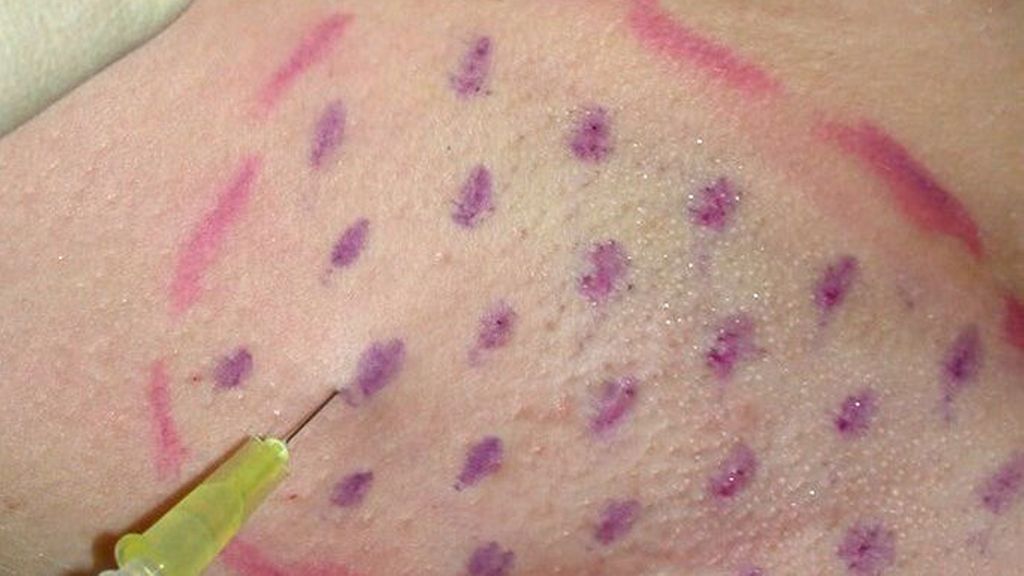
Before each BTX treatment for axillary hyperhidrosis, the points for injection should be marked with a kajal pen, which can easily be removed after treatment. Given that the diffusion radius of the toxin is approximately 1 cm, we found that treatment outcomes improved when injection sites were marked as contiguous 1 cm circles rather than dis-crete points, allowing for uniform toxin distribution without gaps (Figure 2).
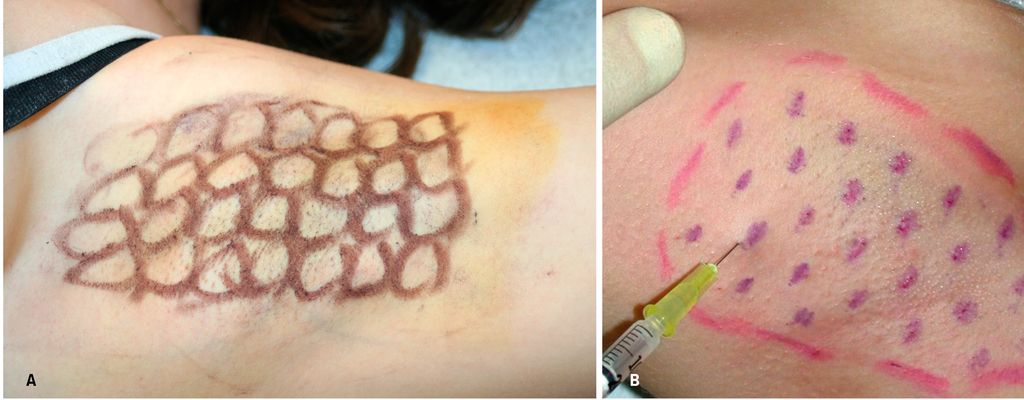
Fig. 2: Injection-site marking. Marking injection sites as adjacent 1 cm circles, reflecting the expected diffusion of botulinum toxin, yields consistently excellent results. Marking only points increases the risk of residual sweating gaps
A reconstitution of ona- and incobotulinum with 5ml has showed to be most effective in the indication of hyperhidrosis.4 Please note, that for aesthetic indications a dilution of 2.5ml is recommended. As the efficacy ratio of ona-/incobotulinum and abobotulinum is 1:2.5, the dilution of abobotulinum is slightly higher to reach this specific ratio. Therefore the reconstitution of ona-/incobotulinum of 5ml and 8ml abobotulinum is recommended and widely accepted.
The total dosage of BTX needed for axillary treatment depends upon the size of the colorimetric response exhibited by the Minor starch test, which in most patients is a surface area of approximately 7x13cm (90cm2). Since the diffusion capacity of BTX is about 1cm in radius diameter, 20 to 30 points injected at a distance of approximately 1cm apart are sufficient to cover an area of 90cm2. Using 2U of ona- and incobotulinum toxin per injection point (equally 6U abobotulinum) a dosage of 50U ona- or incobotulinum per side (½ vial per side) and of 125U abobotulinum is needed for com-plete anhidrosis.
As the sweating area of each patient can differ in diameter, demonstrated by the Minor stark test, the total dose of botulinumtoxin per treatment should be defined by the amount of the injection points multiplied by 2 U (i.e. 20 injection sites x 2U = 40U per side). In other words the rule of thumb of ½ vial per side and 1 vial per treatment can vary from patient to patient.6 As the procedure itself causes minimal discomfort, we routinely abstain from using anaesthesia for axillary treatment. Some authors recommend pretreatment with Emla® cream under occlusion for approximately 30 minutes prior to injection. In Europe, botulinum toxin is generally reconstituted with preservative-free saline, whereas the use of preserved saline has been suggested by some authors to reduce injection-related pain.7 However, clinical experience has shown no relevant difference in patients’ pain perception between the two approaches.
Anaesthesia of the palms after Kreyden8
Injections into the palm of the hand are painful, especially considering that approximately 50 injections are required per palm and that the treatment must be repeated about every six months. Nerve blocks are time-consuming; very often, the onset of action is delayed and/or the effect is incomplete. Emla® cream under occlusion for one hour or more gives an excellent anaesthetic effect against the stinging of the needle, but only minimal relief from the burning experienced during the injection of the fluid. Moreover, the topical application of an anaesthetic cream with occlusion for one hour produces maceration and swelling of the hand, which makes it extremely difficult to find the correct depth to inject the BTX. Therefore using Emla® cream before treatment can lead to incomplete results. Topical combination anaesthesia with iontophoresis with 2% lidocain solution for 30min followed by superficial spray of liquid nitrogen immediately before injecting provides sufficient anaesthesia, ensuring that the treatment is comfortable for the patient. In an experimental survey of 36 patients this combined iontophoresis/cryotherapy anaesthesia technique resulted in an overall satisfaction rate of 92.3% of all patients, compared to only 37.8% in a group treated with Emla and 17.8% in a group treated with nerve block.8 The low level of satisfaction after nerve block is attributable not to insufficient anaesthetic efficacy, but to the pronounced side-effect profile of this technique.
In summary, the anaesthetic technique described by Kreyden provides excellent anaesthesia with high patient satisfaction and no major side effects.
Literatur:
1 Schantz EJ, Johnson EA: Botulinum toxin: the story of its development for the treatment of human disease. Perspect Biol Med 1997; 40(3): 317-27 2 Scott AB et al.: Pharmacologic weakening of extraocular muscles. Invest Ophthamol 1973; 12(12): 924-7 3 Bushara KO et al.: Botulinum toxin - a possible new treatment for axillary hyperhidrosis. Clin Exp Dermatol 1996; 21(4): 276-8 4 Kreyden OP et al.: Type A botulinum toxin: a new methods in treating focal hyperhidrosis. Praxis (Bern 1994) 2000; 89(21): 909-15 5 Kreyden OP: Botulinum toxin in treatment of axillary, palmar and plantar hyperhidrosis. In: Redaelli A (ed): Botulinum toxin A in aesthetic medicine with treatment for hyperhidrosis and odontostomatology. Officina Editoriale Oltroarno Firenze 2010; 199-219 6 Kreyden OP: Botulinumtoxin und Hyperhidrose: Botox leicht geamacht! Eine Anleitung für gute Therapieresultate. Kongressband Münchner Fortbildungswoche 2012; 12: 357-61 7 Allen SB, Goldenberg NA: Pain difference associated with injection of abobotulinumtoxin A reconstituted with preserved saline and preservative-free saline: a prospective, randomized, side-by-side, double-blind study. Dermatol Surg 2012; 38(6): 867-70 8 Kreyden OP: Focal hyperhidrosis: diagnosis, treatment and follow-up. A new method for local anaesthesia in the hyperhidrosis treatment for the palms with botulinum toxin injections. In: Andre P et al.: Cosmetic Medicine and Surgery. CRC Press, Taylor & Francis Group 2016; 18: 155-72
Das könnte Sie auch interessieren:
Supportive Onkodermatologie 2026
Der vermehrte Einsatz von Tumor-Immuntherapien hat in den letzten Jahren zu einem grundlegenden Wandel in der Onkologie geführt. Während Immuncheckpoint-Inhibitoren die ...

Klimawandel und neue Infektionskrankheiten im Blick behalten
Aufgrund des Klimawandels wurde in letzter Zeit ein deutlicher Anstieg neu auftretender Infektionskrankheiten in Europa verzeichnet. Dies führt zu neuen Herausforderungen sowohl bei der ...
Die menschliche Haut in der modernen Kunst
Dr. Ralph Ubl, Professor für neuere Kunstgeschichte an der Universität Basel, stellte sich der schwierigen Herausforderung, einem Raum voller erwartungsvoller Dermatologen das Organ Haut ...